Friends and fellow New Yorkers,
I first got online in college, with a dial-up modem and no idea of how much the internet would come to reshape and dominate our lives. Government services, educational and employment opportunities, urgent information, community support – all of these run through a router. We cannot afford to be disconnected, yet many can’t afford to connect.
The digital divide is more than generational – it’s geographic, and it’s economic. Some neighborhoods – primarily Black and Brown, lower-income areas – are paying the highest rates for the slowest speeds. Many more are relying on solely their cell phones for access, and that disparity has real-world consequences. The same communities that have long been cut off and discounted from services through both physical infrastructure and systemic injustice risk being left behind online as well.
The internet today is as foundational and essential as any other utility, but our city has yet to treat it as such. Some of the infrastructure we rely on for internet access hasn’t been updated since those first days of dial-up, and some of the legal frameworks for its access predate the telephone itself.
While the city has taken some important steps in recent years to renew infrastructure and reach people, including through public-private partnerships that have had real impact, we can go further. By leveraging existing infrastructure and building new pathways, we can create a municipal system that provides affordable and accessible internet for all. This has been achieved in other municipalities, and models exist in the five boroughs today that we can learn from and build upon. New Yorkers deserve an option designed for the public, not for profit.
In an era when rates are rising and affordability is the central concern of our city, we cannot miss this opportunity. Our team’s report reviews the current state of internet access and sets forth a path to expand it. The World Wide Web was founded on the deeply democratic principle that we should all have access, to come together in a worldwide community. To deliver on that vision, it’s time to get connected.
Sincerely,
Jumaane D. Williams
Executive Summary
The average New Yorker still struggles to find a good at-home internet plan in 2026. Many consumers are forced to choose a specific internet service provider, because only one company services their neighborhood. The lack of competition across large parts of the city drives up prices for basic service, hides the real cost of internet packages, and produces poor service quality. Yet consumers endure these barriers, because internet access has become a necessity. Lower-income New Yorkers face the steepest obstacles, which makes them far less likely to have an internet connection at home.
Lack of a stable internet connection at home limits job opportunities, educational advancement, and even the ability to engage in basic city services. The non-profit, Community Service Society, found that, “[F]our out of every ten low-income New Yorkers reported that lack of internet access and working devices kept them from completing online schooling...”[1] Online counseling and telehealth services have often become the preferred method by many insurance providers. Many New York City government services have moved mostly online, such as New York City’s Housing Connect Portal to access affordable housing.[2]
The New York City Council passed Local Law 153 of 2025 on October 9, 2025, and it went into effect on November 10, 2025. The legislation requires the Office of Technology & Innovation (OTI) [3 - The text of Intro No. 1122-2024 references the Department of Information Technology and Telecommunications (DoITT) as the agency to carry out these responsibilities. DoITT was renamed the Office of Technology and Innovation (OTI) in 2022.] to create an internet master plan. Ideally, the plan should focus on “how the department may work with franchisees and internet service providers, including but not limited to non-profit or community-based internet service providers, and internet service providers that are emerging business enterprises”, as well as “utilizing city-owned property for the installation of network infrastructure”. The department will also “make any recommendations regarding the utilization of any unutilized or underutilized network infrastructure, including unutilized fiber strands” and assess “the availability of public and private grant programs to encourage private investment in network infrastructure.”[4] As a co-sponsor of the bill, the Public Advocate supports the law’s implementation and asks the department to consider the recommendations in this report.
This report, Municipal Internet in NYC: A Review of Past Digital Equity Actions and a Look to the Future for the Internet as a Right, will review the current internet equity programs, assess past performance of prior initiatives, provide an overview as to what municipalization entails, and provide recommendations on what kinds of internet infrastructure to build as OTI forms a new plan for internet accessibility and affordability.
What is the Internet?
In order to talk about the internet, first one needs to understand the basic infrastructure of a network. A network is a group of computers communicating with each other, and the global internet is essentially a large network of networks. A singular network can be composed of one’s personal devices, such as laptops, phones, and printers, that can communicate with each other through a router.
For example, when both a computer and printer are connected to the same home-network, the computer can talk directly to the printer over the local network (via the home router) instead of communicating over the larger internet. Depending on your Internet Service Provider (ISP), your router can be connected to the internet wirelessly or through cables, which allows one’s personal devices to communicate with the larger internet. Each ISP (i.e., Verizon, Optimum, Spectrum) runs as their own network and they are also made up of networks that may be separated by neighborhood, district, or another geographic point called neighborhood tabulation areas (NTAs).
All ISPs eventually connect through facilities called Internet Exchange Points (IXPs). An IXP also connects to the trans-atlantic cable, which connects the internet globally, creating what is known as the World Wide Web. An IXP facility connects networks via technology known as “switches” and between every individual network there is a switch. These switches assign IP (Internet Protocol) addresses that are used to identify computers in the network, which allows them to direct and filter data. The data goes only to the computer that requests the data. In the past, there were two distinct pieces of equipment that an ISP gave their customers—a modem and a router. Today, the modem is usually inside the router. The modem is a type of switch that connects the home network to the outside network and, through it, to the World Wide Web.
How the Internet Works in NYC
In NYC, internet access is primarily delivered to residences through a mix of traditional cable, fiber optic, and wireless. Traditional cable includes Digital Subscriber Lines (DSL), which uses phone infrastructure. This is faster than dial-up, but is generally slower than other forms of internet connection. Traditional cable also includes coaxial cable, which is the same infrastructure cable TV runs on.
Experts consider fiber the gold standard of internet connection, because it uses strands of glass that transfers data through light by morse-code like signals. Light is 20-40% faster than cables that transfer data through electricity such as coaxial cables. In fact, fiber is futureproof infrastructure, since the speed with which it can transfer data is currently only limited by the processing capacity of the computers attached to it.[5] Fiber is also stronger and more stable, as it offers symmetrical upload and download speeds. Cables that carry data through electricity are often more vulnerable to temperature changes, harsh weather, and dampness than fiber is.[6] Fiber is much more resilient than 5G, as 5G wireless speeds can fluctuate greatly due to building infrastructure or materials.
As of December 2023, 11 ISPs provide fiber optic cable connections directly to customers, known in industry terms as fiber to the premises (FTTP), in New York City, according to the Federal Communications Commission (FCC). Four of these providers are legacy companies: Verizon, Spectrum (owned by Charter), Optimum (owned by Altice), and Astound (owned by RCN). Verizon constructed their broadband network over legacy telephone lines, while Charter, Altice and RCN built service from legacy cable television infrastructure.[7]
INTERNET AVAILABILITY VERSUS ACCESS
While internet infrastructure is available citywide, it is not necessarily within reach of all New Yorkers. In a hearing at the New York City Council’s Committee on Technology on April 29, 2025, the OTI’s Executive Director of Franchise Administration Brett Sikoff assured the Council that nearly the entirety of New York City has access to broadband internet, either through fiber or coaxial cable.[8] As of December 2023, 98.1% of New York City residents had access to purchase internet service with speeds of at least 25/3 (upload/download speed) megabits per second (Mbps). However, not everyone is paying for and receiving those download speeds.
Access data suggests that lower-income households may forgo internet service, use cellular service as their primary source of internet, or utilize a friend, family member, or neighbor’s plan. They might also rely on local institutions to gain access to the internet.[9] While internet service through coaxial cable is available throughout the majority of the City, the highest quality of service provided by fiber optic cable is not available everywhere. In 2022, 25 Census-defined neighborhoods in New York City had no commercial fiber provider on at least a quarter of their blocks. Nearly half of these neighborhoods were in Brooklyn.[10]
GEOGRAPHIC DISPARITIES
Disparities in broadband access are most pronounced at the neighborhood level. In many of the city’s Census-defined neighborhoods[11 - Please note that a Census-defined neighborhood, census tract, community district, and neighborhood are not the same. A Census-defined neighborhood is based on demographic and geographic criteria set by the U.S. Census Bureau. A Census tract is a small area based on population and geographic location for reliably analyzing data collected by the U.S. Census Bureau. A community district is a defined geographic area within a municipality that is for local governance, planning, and development purposes. A neighborhood varies in size and population, but has an identifiable geographic boundary defined by streets, parks, elevated trains or bodies of water.] at least one-third of households have no access to broadband. This includes seven of the Bronx’s 10 census neighborhoods located mostly in the south and central Bronx, three of Brooklyn’s 18 census neighborhoods that includes Coney Island, Brighton Beach, and Ocean Hill/Brownsville, and one census neighborhood in each of the remaining boroughs—Jamaica/St. Albans/Hollis in Queens, Harlem in Manhattan, and the North Shore in Staten Island. All of these census neighborhoods have a poverty rate above the citywide average.[12] 13 out of 18 [13 - One-third of the City’s 55 census neighborhoods equals 18] of the City’s census neighborhoods with the highest shares of households with incomes below the poverty line, also have some of the highest shares of households without broadband access or with cellular service alone.[14 - Ibid., 7.] [15 - The neighborhoods referred to in this paragraph are named according to the Public Use Microdata Areas (PUMAs), which were defined by the U.S. Census Bureau to collect and analyze data below county level for the tabulation of the American Community Survey (ACS) Public Use Microdata Sample (PUMS) data. PUMAs are non-overlapping areas that partition each state or equivalent entity into areas containing no fewer than 100,000 people each. PUMAs generally overlap but are not fully aligned with Community Districts. While the names roughly correspond to recognizable neighborhoods, PUMAs are not meant to define a neighborhood or capture all of the names or ways people understand neighborhoods across New York City. These PUMAs were defined based on the 2020 Census. “Public Use Microdata Areas (PUMAs)”, United States Census Bureau] The Bronx is particularly disadvantaged when it comes to internet access compared with the other boroughs of the city. The borough has the highest percentage of households with income below the federal poverty line, at 28% compared to the citywide average of 18.2%.[16] More than one in three households have no broadband access.
In 2022, 31 New York City neighborhoods had a broadband adoption rate below 60% with a majority of the neighborhoods located in the Bronx.[17] The Bronx also held the highest share of households accessing the internet via cellular data plans alone.[18] The borough also depended on the Affordable Connectivity Program (ACP) far more than the other boroughs.[19 - See “The Affordable Connectivity Program (ACP) & the NYS Affordable Broadband Act” for more information and background on this program] At the time of the program’s cancellation, nearly half of Bronx households depended on it, compared with around a quarter of households in the other boroughs.[20 - Ibid., 4]. The table below lists the 17 New York City neighborhoods with access to internet speeds above 900 Mbps on less than 75% of their blocks. [21]
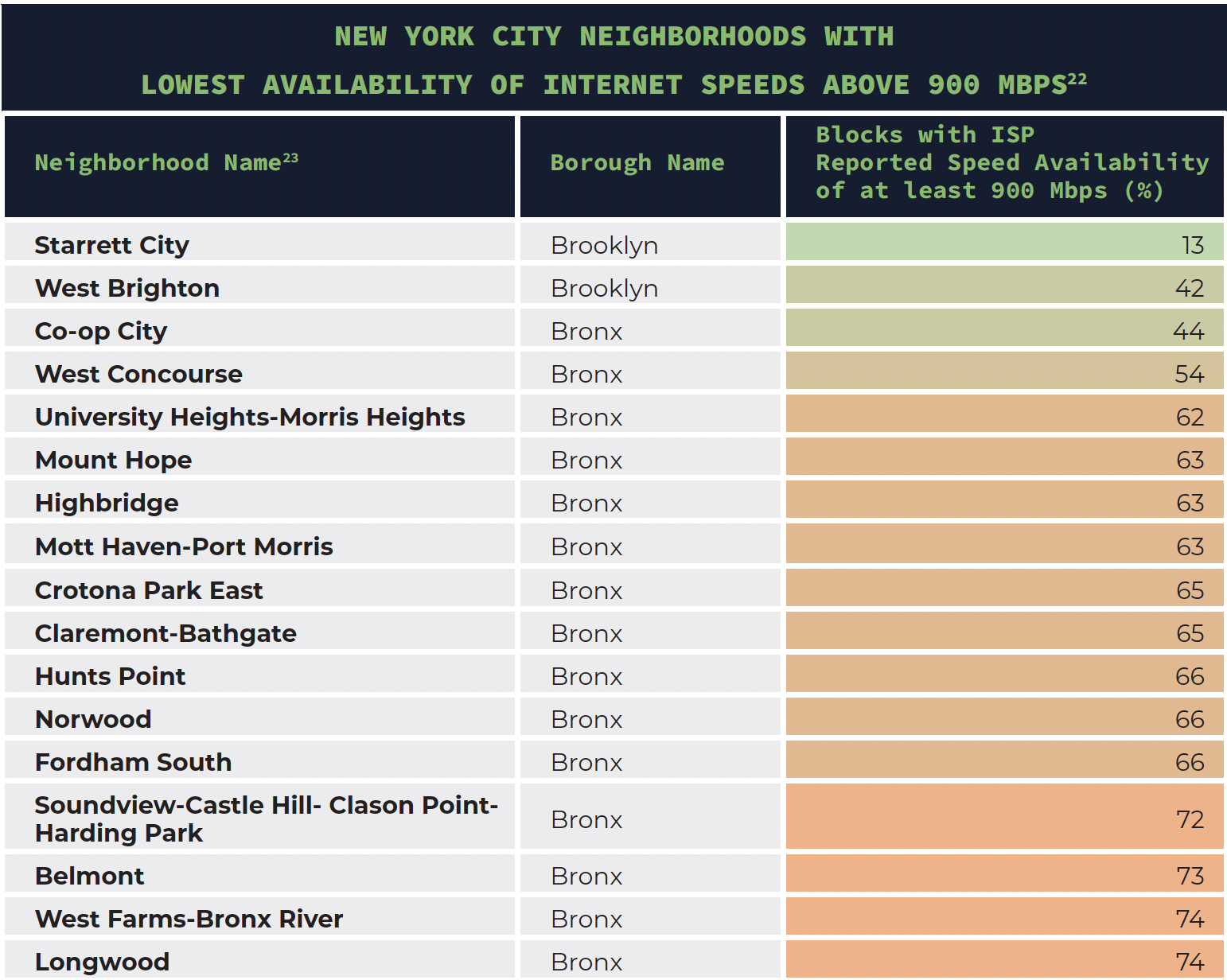
[22 Ibid]
[23- The neighborhoods referred to in this table are named according to the NYC Department of Planning’s (DCP) August 2019 Neighborhood Tabulation Area (NTA) data. These NTAs were created by aggregating census tracts from the 2010 Census and include a population large enough to reduce sampling error associated with ACS while still providing a smaller unit of analysis than a Community District. NTAs offer an even more granular view of neighborhoods than PUMAs, often aiming for populations of 15,000 each. NTAs contain whole census tracts and don’t cross PUMA boundaries. Although the names roughly correspond to recognizable neighborhoods, NTAs are not meant to define a neighborhood or capture all of the names or ways people understand neighborhoods across New York City. “2020 Neighborhood Tabulation Areas (NTAs)”, Open Data NYC]
In 2022, neighborhoods with a home broadband adoption rate below 50% included Williamsburg and Borough Park in Brooklyn, Flushing in Queens, and the Lower East Side in Manhattan. Of the neighborhoods with a home broadband adoption rate below 60%, 3 were in Manhattan [24 - Chinatown, East Harlem North, and the Lower East Side in Manhattan], 4 were in Brooklyn [25 Williamsburg, Borough Park, Seagate-Coney Island, and Brownsville in Brooklyn],18 were in the Bronx [26 - Mott Haven, East Tremont, Claremont-Bathgate, Mount Hope, Highbridge, Hunts Point, Melrose South-Mott Haven North, Fordham South, Bronxdale, University Heights-Morris Heights, Williamsbridge-Olinville, Belmont, Woodlawn-Wakefield, Pelham Parkway, Van Nest-Morris Park-Westchester Square, East Concourse-Concourse Village, West Concourse, and Crotona Park East in the Bronx], and 6 were in Queens [27 - Flushing, St. Albans, Laurelton, Springfield Gardens-South Brookville, Baisley Park, and Hollis in Queens “Internet Master Plan: Adoption and Infrastructure Data by Neighborhood,” NYC Open Data].
MOBILE DEPENDENCY
In 2023, 74.9% of households had fixed broadband, while 14.8% accessed the internet through cellular data alone [28]. Households who access the internet through cellular data face a disadvantage, because many mobile online resources are less capable than their desktop equivalent [29 - Ibid.]. Neighborhoods with a high percentage of households that utilize mobile service instead of fixed at-home broadband, known as mobile dependent, may indicate that households have a desire to connect to the internet, but insufficient resources for a dedicated at-home connection. Neighborhoods with mobile dependency rates at 15% or higher were all in either the Bronx or Queens [30].
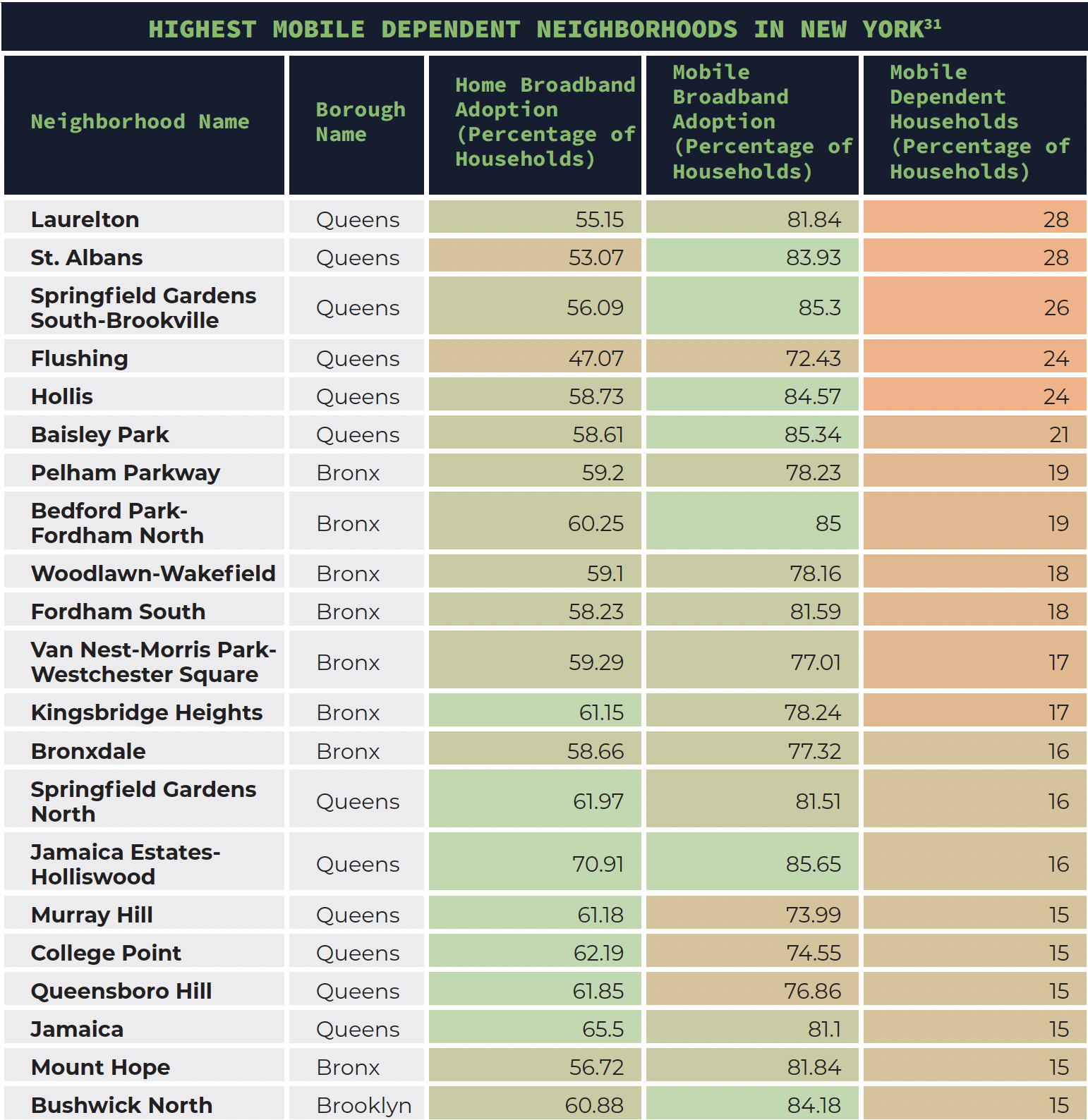
[31 - Ibid.]
PRICE FAIRNESS
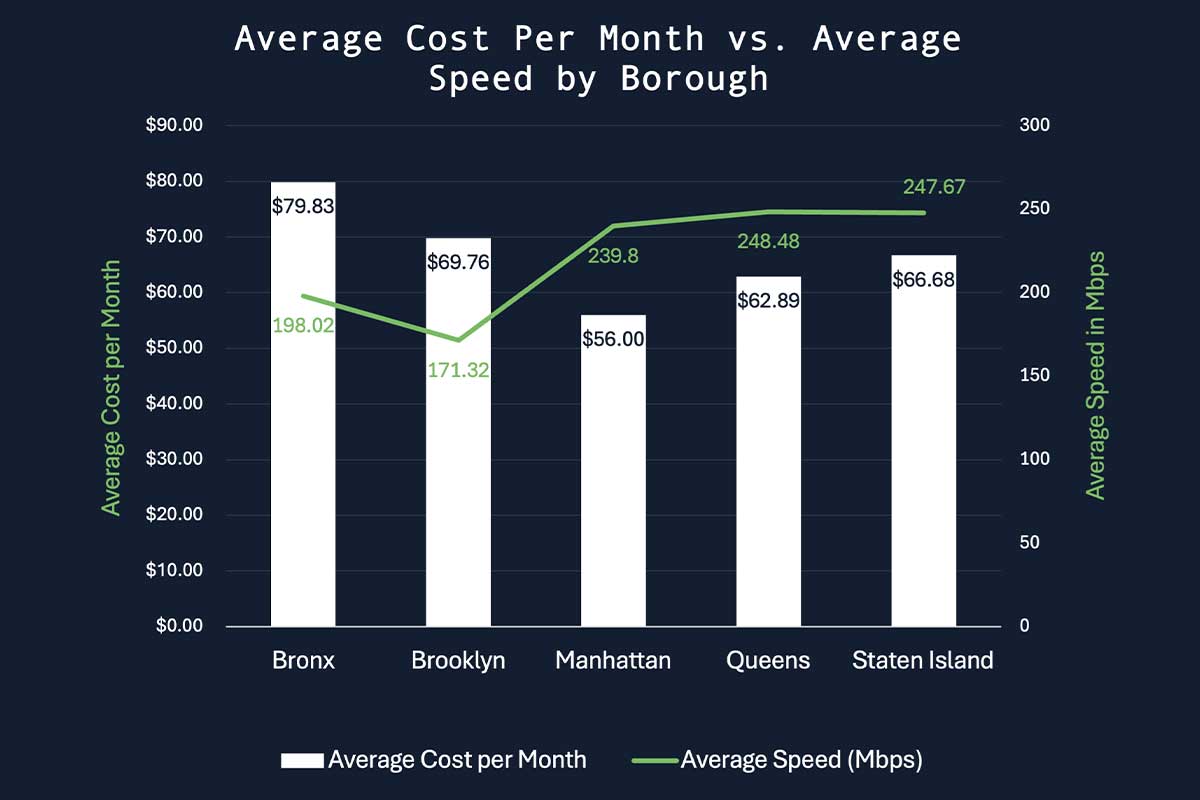
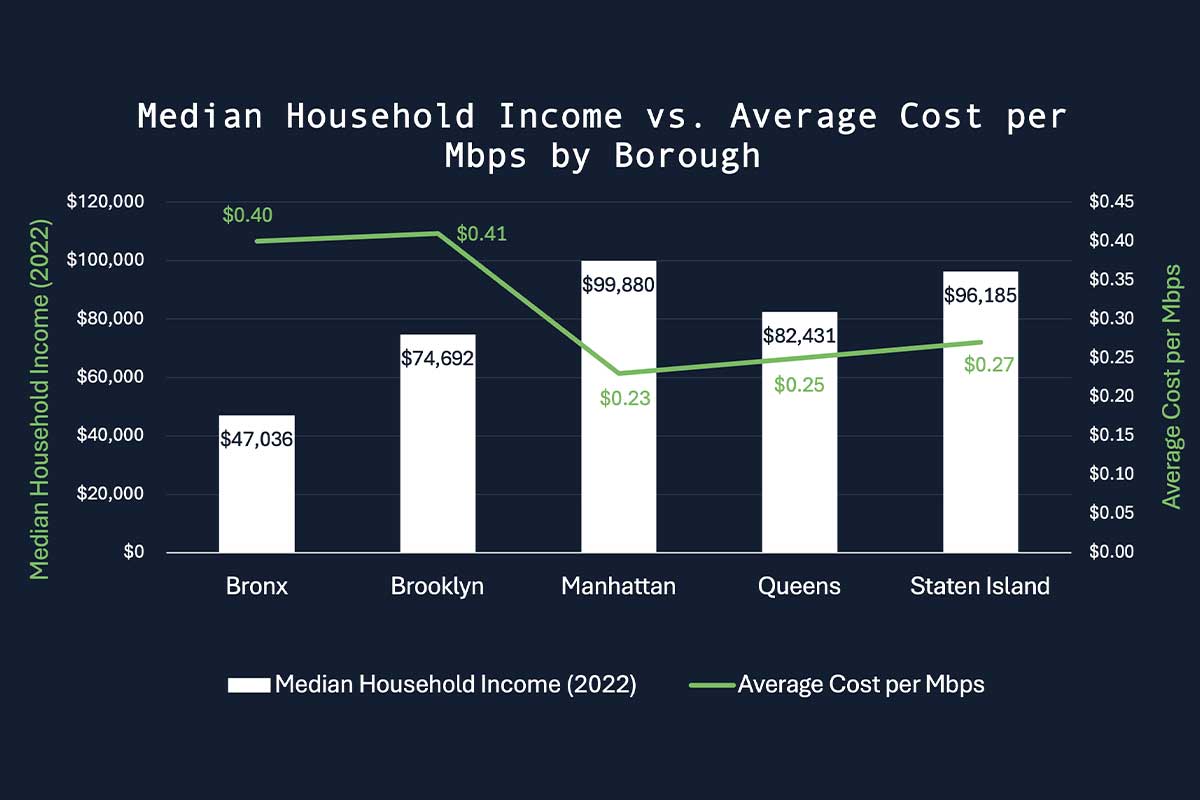
The average price for 100/20 Mbps broadband is highest in the Bronx ($79.83/month) and lowest in Manhattan ($56.00/month) [32]. In the Bronx and Brooklyn, internet bills amount to about 40% of the cost of electric bills [33 - Ibid.]. 2024 data illustrates that customers in the Bronx and Brooklyn not only paid, on average, the highest internet bills of the boroughs, but received the slowest average internet speeds. This means that Brooklyn and Bronx residents pay, on average, nearly double the cost per Mbps of internet service. Bronx residents also pay by far the largest portion of their incomes to the internet compared to the other boroughs [34].
Average Cost and Speed by Borough [35 - Ibid.]
Citywide Internet Infrastructure Landscape: Internet Master Plan, Big Apple Connect and the Large ISPs
INTERNET MASTER PLAN — MAYOR BILL DE BLASIO’S PLAN
Announced in January 2020, then-Mayor Bill de Blasio set forth a comprehensive plan called the “Internet Master Plan” to close the digital divide in New York City. The Internet Master Plan set out not only to build critical broadband infrastructure to provide every New Yorker with affordable, reliable, high-speed broadband, but also to uplift smaller ISPs, particularly ISPs that are Minority/Women-owned Business Enterprises (M/WBE). The Internet Master Plan’s economic analysis reported that this would create 165,000 new jobs, a $142 billion increase in gross city product, and a $49 billion increase in personal income by 2045.
The Internet Master Plan proposed public-private partnerships to fund development where multiple private and non-profit ISPs share city-owned property. This arrangement would give the City more control over how providers operate and make it easier for small ISP startups to enter into the market. This, in turn, can help break the large ISP monopoly system that currently exists in New York City. The Internet Master Plan identified several City assets, as well as pathways for broadband to be utilized based on the best fit. A neighborhood that might not yet have the existing infrastructure for fiber or may have unique challenges in building out the infrastructure might, for example, be better fit for a mesh network.
A mesh network uses transmitters or antennas to create networks by repeating wi-fi signals from one antenna to another across a given area. Some may already be familiar with mesh networks as a series of wifi routers that help to extend signal from one side of a house or business to another, and thus eliminating dead zones, but they can operate on a much larger scale across a neighborhood or a city. In some areas, mesh infrastructure may make the most sense to invest in, as it can be much cheaper and less intensive to implement, only requiring placement of antennas on the roofs of buildings that are opting in.
Running fiber underground through conduits already located beneath the streets could be an option for neighborhoods with an existing underground conduit system. The Internet Master Plan proposed building “neutral host” wireless mobile infrastructure such as 5G service that could be shared by multiple mobile wireless providers. For broadband, neutral host infrastructure includes dark fiber defined as unused and/or abandoned existing fiber-optic cables that could be shared rather than owned by a single company. It specifically emphasized supporting M/WBEs and community-based organizations to build out the infrastructure. This involved adding M/WBE subcontracting requirements in existing contracts with non-M/WBEs. Public assets to use included City-owned rooftops, rooms within City buildings, and other available street infrastructure like streetlights and utility poles.
The Internet Master Plan set out to combine City seed investments in infrastructure and already-existing public assets with complementary funds from private partners. Private companies would benefit through the ease and affordability of using public real estate assets, a reduced risk because they didn’t have to buy or use their own property, and a competitive edge of speedier deployment. Private and non-profit entities would be responsible for building out and maintaining the infrastructure. If the private partner failed in its commitments, the City would have the right to take over or transfer operational control to another private entity. Over time, this new infrastructure would increasingly benefit operators through lower costs on infrastructure spending. Smaller companies, M/WBEs, non-profits, and innovative ISPs would be able to expand their services across New York City because shared infrastructure absorbs the majority of the costs.
The plan was praised by experts as “groundbreaking,” and was one of the most ambitious and comprehensive plans in the nation for closing the digital divide [36]. However, the Internet Master Plan was canceled by the Adams administration just as the initial pilot programs were being rolled out. As will be explained in the following section on Big Apple Connect, cancelling the Internet Master Plan was devastating for non-profits and small ISPs who invested tens of thousands of dollars to purchase equipment and begin installations for this initiative and did not get paid for their work. Additionally, eliminating the Internet Master Plan empowered corporate ISPs like Verizon, Optimum, and Spectrum to continue their de facto monopolies, especially in those New York City neighborhoods with only one available corporate ISP.
Critiques of the Original Bill de Blasio Internet Master Plan
In March 2023, Chief Technology Officer of the OTI, Matthew C. Fraser, appointed by Mayor Eric Adams, claimed that the prior Internet Master Plan was not getting the results necessary to quickly deliver internet service to New Yorkers in need [37]. OTI thus reversed course from the de Blasio administration’s plan and argued that they wanted to deliver internet connection to lower-income New Yorkers more immediately. Mayor Adams’ answer was the Big Apple Connect, which will be discussed in the following section.
What critics like Fraser didn’t acknowledge was that a key feature of the Internet Master Plan was to provide immediate affordable internet connectivity for more than 250,000 low-income New Yorkers, including New York City Housing Authority (NYCHA) residents. In October 2021, Mayor Bill de Blasio had already announced that as part of his Internet Master Plan, the City partnered with M/WBE ISPs to connect 40,000 residents in 18 NYCHA developments by the end of the year. He also announced plans to connect an additional 70,000 NYCHA residents, as well as 150,000 residents in the surrounding communities, by early 2022 [38]. An important note, the Internet Master Plan came out two months before the COVID-19 pandemic which functionally shut the City down and brought all construction and infrastructure projects to a standstill.
BIG APPLE CONNECT - MAYOR ERIC ADAMS’ PLAN
Established by Mayor Adams’ administration in September 2022, Big Apple Connect aims to reach residents of NYCHA who cannot afford at-home internet. OTI chose Optimum and Spectrum as the service providers because of their established presence within public housing developments, and because they also provided cable TV service, a requirement of the request for proposals (RFP). Big Apple Connect has separate contracts for individual NYCHA developments. This plan requires ISPs to offer a discounted plan costing no more than $30 per month to residents, and the City of New York covers the $30 cost for participants who receive essentially free internet. Big Apple Connect could provide 330,000 residents in 150,000 households with free at home internet [39]. This number includes those with existing internet service who convert their plan to Big Apple Connect. The contracts guaranteed these ISPs more customers from a consistent and reliable customer base.
The City pays Spectrum and Optimum $30 per month for a maximum of 150,000 eligible households totaling $54 million a year [40 - $30 x 150,0000 households x 12 months = $54,000,000]. As of April 2025, 80% of NYCHA residents were utilizing the program [41], and OTI reported Big Apple Connect costs at $38 million a year [42]. OTI originally signed a three-year contract with these ISPs. The contracts also included an option for ISPs to exercise 12-month extensions after the initial three-year contracts expired, which occurred in September 2025. Instead of a 12-month extension, the Mayor extended the contract for three more years, locking the City into a total of $114 million [43 - Ibid.], and a potential maximum of $162 million [44 - $54,0000 per year x 3 years = $162,000,000] if the budget ceiling is reached. While OTI insisted they will be able to renew this program as a baseline budget past 2028 [45], there is no proof or guarantee. ISPs could refuse to continue this program and/or a new mayoral administration could redirect funding within the agency or to another agency.
Critiques of the Big Apple Connect
It has been argued that when Big Apple Connect was implemented, the City failed to uphold its agreements with non-profit and smaller ISPs that were actively installing and providing internet services for specific communities. Under the Internet Master Plan, the City agreed to hire a cooperatively-owned internet service provider, People’s Choice Communications (PCC), to build out its internet infrastructure in several NYCHA buildings. PCC is a worker-owned cooperative that was formed by Spectrum workers who refused to accept Spectrum reducing health benefits and wages for workers. PCC installed the rooftop antennas and wifi nodes which provided internet to 2,500 residents in the NYCHA Melrose Houses [46]. The internet was community-owned and the residents were to elect a board of advisors to have a voice in decisions like data governance, service quality, and use of proceeds [47].
After Big Apple Connect was rolled out, the City canceled PCC’s contract and instructed it to dissemble its equipment (which had been paid for out of pocket). Additionally, Big Apple Connect contracted with Spectrum to provide internet to Melrose Houses, the same ISP whose previous actions led to PCC being created in the first place [48].
The Affordable Connectivity Program (ACP) & the NYS Affordable Broadband Act
At implementation, critics of Big Apple Connect called the plan redundant, as the federal Affordable Connectivity Program (ACP) already applied to New York City residents. Passed in 2021 in an attempt to get people online during the COVID-19 pandemic, the ACP took $30 per month [49 - In 2022, the Biden-Harris Administration secured commitments from 20 leading nation-wide ISPs to provide a basic plan of 100mbps at a maximum of $30 per month.] off consumers’ internet bills. Many ISPs offered plans in the $30 per month range, which meant that the ACP would cover the standard plan in full or a majority of it for most New Yorkers. Nearly all NYCHA residents would have qualified for the ACP’s income requirements. If the City had spent a fraction of the budget of Big Apple Connect to promote the ACP, then the City would have saved money and still have the same end result. Furthermore, instead of the City of New York paying $162 million to a few large ISPs, the city should have invested the money into building out its internet infrastructure. With actual infrastructure owned by the City, it would permanently bring down prices, rather than relying on fleeting subsidies.
While this program has expired, New York State in 2025 enacted legislation called the New York Affordable Broadband Act (ABA) that effectively replaced the program. ABA requires large ISPs to offer plans of 25 Mbps (or more) for $15 per month. ISPs can also comply with the law by offering plans of 200 Mbps (or more) for no more than $20 per month. Eligibility covers most if not all NYCHA residents.
Eligibility requirements:
- Supplemental Nutrition Assistance Program (SNAP)
- Medicaid
- Senior Citizen Rent Increase Exemption
- Disability Rent Increase Exemption
- Affordability benefit from a utility, such as the Home Energy Assistance Program (HEAP)
- Free or reduced-priced lunch through the National School Lunch Program [50]
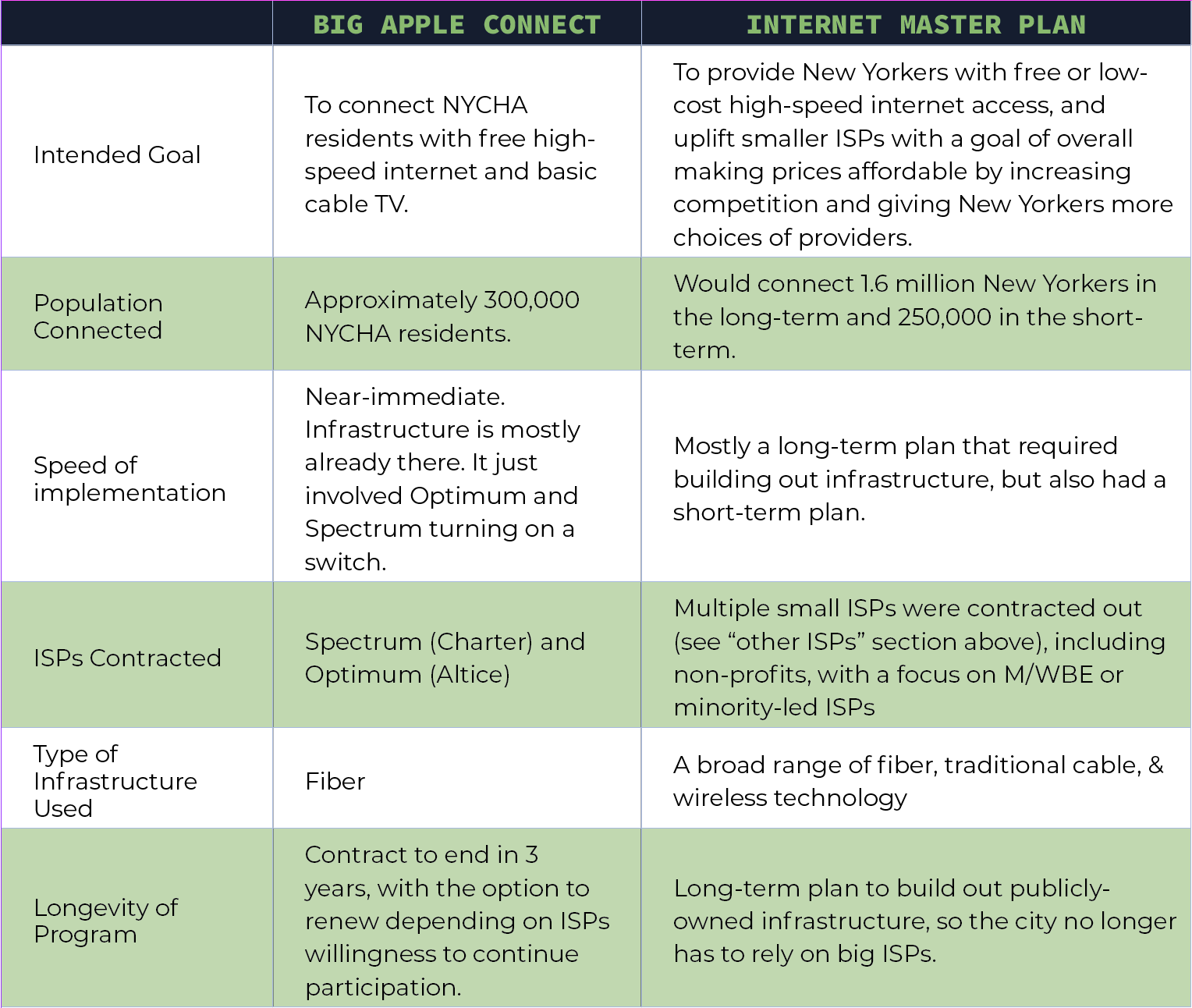
Below is a chart explaining the difference between the current Big Apple Connect plan and the prior Internet Master Plan:
THE CITYBRIDGE FRANCHISE AGREEMENT
In the early 2000s, the City of New York looked to replace largely unused payphone infrastructure across the five boroughs. In 2014, an exclusive franchise was granted by the City to Citybridge, a private corporate consortium, in an effort to close the digital divide. Under the franchise agreement, Citybridge would remove all the pay phones across the city and replace them with public wifi infrastructure that would be operated without remuneration. CityBridge agreed to build and install LinkNYC kiosks providing internet-enabled devices to receive free wifi within the range of the kiosk, as well as make free phone calls at the kiosk by using the screen and keypad.
Citybridge was chosen as the winning bidder in the RFP. The RFP included paying the City from profits generated by renting advertising space on the kiosk’s screen. CityBridge proposed minimum payments to the City with certain monetary increases tied to any increases in their profits from advertising. Their projected profits would result in hundreds of millions of dollars in revenue for the City, as well as giving 10% of advertising space and time on the kiosk to the City. The CityBridge consortium consists of the following companies: Control Group, Titan, Qualcomm, Comark, Transit Wireless and Antenna Design [51]. In 2015, the Google-owned Sidewalk Labs bought Control Group and Titan to create a new company called Intersection, inserting itself into the Franchise Agreement [52 - Ibid., 14]. Unfortunately, Citybridge’s projections were not met and it was unable to make payments to the City. A major partner of CityBridge outside of the consortium is Boldyn Networks (formerly ZenFi Networks) which invested $200 million into upgrading the kiosks for LinkNYC 5G deployment [53] and enabled Citybridge to make a partial payment of its outstanding debt to the City and an installment plan for the balance.
There have been several positives from the CityBridge franchise agreement. LinkNYC kiosks have become ingrained in the fabric of New York City for offering a place to charge electronics, to make free phone calls in case of an emergency, and offering free wifi. LinkNYC’s most frequently dialed phone number is for the New York State hotline for Electronic Benefits Transfer (EBT) [54]. EBT is an electronic system used for receiving and disbursing government benefits for programs such as SNAP. LinkNYC kiosks can be the only way for tens of thousands of low-income New Yorkers to have access to a working telephone, and to conveniently resolve any social services issues. Yet the progress above must be contextualized to what led to these successes.
In November of 2014, the Office of the NYC Mayor and LinkNYC agreed to a contract of $500 million in guaranteed revenue in the first 12 years (2014-2026) with $750 million in guaranteed revenue by 2029 [55]. Revenue projections, however, were only met once from 2014 to 2019 [56 - Ibid.]. In 2018, CityBridge stated that they could not meet their own revenue projections and needed modifications to the franchise agreement. Thus there was another amendment to the franchise agreement to change LinkNYC’s timeline of required installations. However, CityBridge continued to encounter financial challenges. After the amendment, Citybridge made a request to expand its privacy policy to collect additional data from its users in order to meet financial obligations. Although the City denied the request, Citybridge unilaterally revised its privacy policy on the July 4th weekend of 2017 expanding the scope of data collected. Citybridge reversed this unilateral decision when the City sent it a cease and desist letter [57].
Around this time, Citybridge stopped installing and maintaining LinkNYC Kiosks. It argued it did not have enough funds from advertising to keep going. CityBridge had mostly installed LinkNYC kiosks in the most high-value areas in Manhattan. As stated by the Commissioner of the Department of Information Technology and Telecommunications (DoITT), OTI’s predecessor, in fall 2018, many of the kiosks that were not installed were in low-income neighborhoods [58].
In 2019, LinkNYC became delinquent with the City by $60 million in minimum payments – $70 million when interest was included. The New York State Comptroller’s Office investigated LinkNYC in July 2021, and found that “DoITT did not sufficiently monitor, oversee, and enforce CityBridge’s compliance with the franchise agreement terms [59].” CityBridge and the City agreed to restructure the debt, so that LinkNYC kiosks will continue to be serviced and the City will still receive the money it was owed. $25 million was to be paid immediately, with $35 million to be paid out in monthly installments totaling a minimum of $3 million each year [60]. In an April 2025 hearing of the NYC Council’s Committee on Technology, OTI’s Franchise Administration Executive Director Brett Sikoff testified that CityBridge is continuing to meet its minimum monthly payments on time [61].
LINK 5G
In 2021, CityBridge pushed the Mayor’s Office to amend the franchise agreement because the consortium looked to pivot its business operations to diversify rather than rely solely on advertising [62]. CityBridge designed new 32-foot-tall towers as the next generation kiosk which will lease out space for 5G equipment to a limited number of ISPs and mobile carriers, so that these private companies can provide 5G service to its customers. CityBridge argues that the funding is a more stable source of revenue as opposed to prior advertiser-focused revenue. The towers will also offer the same benefits to the public as the prior LinkNYC kiosk, such as free calling, a charging station, and free wifi within a one-block radius of the tower. These “Link5G” towers will now be installed in the majority of formerly planned LinkNYC kiosk sites, with at least 4,000 Link5G towers to be installed by 2026 [63]. Using 5G technology, Link5G towers are a way to provide internet service, especially in neighborhoods where it can be challenging to install a traditional fiber connection. CityBridge argues that, as most newer phone models coming out use 5G, we must think ahead of time for 5G, because 5G connections are shorter in length. The frequency does not carry as far for 5G towers, and thus there needs to be thoughtful advance planning for adapting the City’s infrastructure to accommodate 5G internet access. They further argue that the towers could also be used beyond 5G equipment, and house the next several generations of technology.
However, there has been a concerted effort to curb the installation of Link5G towers in the city by neighborhood preservation groups, privacy rights groups, and community organizations. They argue that the City should focus on building out wired internet, as fiber is faster and more efficient than having wireless internet. Also, there needs to be clear criteria articulated and provided by OTI and CityBridge as to why towers are sited in certain locations. In many cases towers are installed in front of people’s homes, which they argue have been disruptive. There have been reports of property owners receiving little to no notice before the installation of a tower. Other concerns include, fear of questionable levels of wireless radiation, and whether they will hold up in a storm. Additionally, given that many New Yorkers can’t afford 5G phones to utilize the infrastructure, it fails one of the key aims of this project: to close the digital divide. It appears that ISPs, telephone companies, and CityBridge will get the most benefit from the franchise agreement, particularly since there is only a free wifi hotspot within a one block radius and the wifi does not penetrate building walls. Lastly, the towers are not visually appealing, and don’t blend well into most NYC neighborhoods [64].
Anti-Link5G advocacy groups and concerned community members worked with Congressman Jerrold Nadler’s office to write a letter to the FCC urging the federal government to take action against the installation of Link5G towers, because the installation process was not in line with Section 106 of the National Historic Preservation Act (NHPA). Section 106 “requires that each federal agency identify and assess the effects its actions may have on historic buildings.” CityBridge or OTI has not run the Link5G installation plan through the federal government while still building the Link5G towers in historic districts [65]. The FCC sent a letter in response to Congressmember Nadler, and made clear that OTI and CityBridge cannot build new towers, and then go through the FCC process when they want to start housing carriers’ equipment. Rather, the FCC stated:
The Commission’s rules implementing NHPA and NEPA [National Environmental Policy Act] review are applicable prior to deployment of towers designed to host communications equipment that would rely on the use of FCC-licensed spectrum; not after construction or after there is a contract with a communications provider to house equipment on the towers.
Furthermore, the FCC stated later in the letter that CityBridge must be in compliance with already installed towers, and that if any Link5G tower wants to have a carrier’s antenna installed, then OTI needs to conduct and complete the NHPA and NEPA reviews. CityBridge responded by saying that they will be working with the FCC to make sure that Link5G towers are in line with FCC guidelines, but ultimately will not affect the scheduled implementation of Link5G towers [67].
As of 2024, only two of 200 already installed Link5G towers have been installed with 5G equipment. “Delayed installations and cooling enthusiasm around 5G technology have discouraged carriers like Verizon from using the towers to build out their networks, experts say [68].” So we have yet to see how the next phase of Citybridge will play out financially and for the City as a whole.
Flaws in the Public-Private Partnership Internet Model
Privately owned internet is like any other privately owned utility – their primary goal is to satisfy their investors through growth and profits, which eventually leads to consolidation. As ISPs continue to merge, this consolidates the market to fewer and fewer companies each year. As seen in the neighborhood census, discussed earlier, decreased competition leads to higher prices and poor service. Another underreported result of market consolidation is the lack of accountability when dealing with large ISPs.
LACK OF ACCOUNTABILITY/ENFORCEMENT
Verizon
In 2008, Verizon entered into a non-exclusive franchise agreement with DoITT to expand their fiber optic service (branded FiOS by Verizon), which would be available to all residential buildings in New York City upon request [69]. Similar to the ISP franchise agreement under Big Apple Connect, this franchise agreement was technically aimed at providing cable TV, but as a fiber network it could also be utilized to connect New Yorkers to the internet. The work was to be completed no later than June 30, 2014 [70].
In 2015, an audit by DoITT found that Verizon was not honoring its agreement to provide connectivity to all the residential buildings that requested it. DoITT found that even though Verizon had claimed it had fulfilled the work required by the franchise agreement, there were still areas where FiOS was unavailable. Additionally, DoITT reported instances where Verizon had explicitly stated to customers that they had no intention to deliver service to specific neighborhoods. The audit also claimed that Verizon, in violation of the franchise agreement, had failed to provide access to tracking systems, databases, and contracts during the course of the audit. To the extent that it did provide documents and information requested, Verizon did not provide the records within the mandated timeframe in the contract. Additionally, the audit found that 75% of over 40,000 requests for service had been outstanding for over one year. DoITT also identified complaints and interviewed several property managers who reported that Verizon wanted exclusive agreements to certain large residential buildings before Verizon would agree to building installations [71]. Exclusive agreements would prevent customers from being able to use other providers. This is also explicitly a violation of the franchise agreement to service anyone who requested FiOS and a potential violation of the Federal Communications Commission’s ban on exclusive cable video contracts in multiple dwelling units [72]. When the City sampled 52,000 addresses for FiOS availability one year later in 2016, it found that 11% of residents in upper Manhattan and 19% in central Brooklyn, compared to 90% in Staten Island, could get access to FiOS in seven days. Furthermore, two-thirds of public housing developments did not have access to Verizon services [73].
In 2017, New York City sued Verizon for a breach of the franchise agreement [74]. When the lawsuit was filed, Verizon reported they had connected to 2.2 million households out of New York City’s estimated 3.1 million households [75]. About one million households were left without access to the Verizon FiOS network. Verizon’s defense came down to the definition of the word “pass.” Under the agreement, Verizon was required to pass all residences. Verizon argued that during the signing of the agreement in 2008, both parties agreed that the word did not mean to pass in front of or behind, and connect to every residence in New York City. The agreed upon definition of the word, according to Verizon, was that a home is passed with fiber as long as the wires are near enough to the building that it can be feasibly installed in a reasonable amount of time if requested by a prospective customer. Under this definition, Verizon could provide connectivity to a building at a nearby intersection and say that every building on surrounding blocks are “passed”, thus fulfilling their obligations mandated by the agreement. They did not have a mandate to connect the homes on those blocks. Under that definition, Verizon said, the franchise agreement generally required them to use their existing routes and replace their copper network with fiber-optic cables [76].
In the lawsuit, the City disputed this claim, referencing a petition Verizon submitted to the Public Service Commission in 2008, which stated that in order to achieve the goals of the franchise agreement, “Fiber-optic distribution facilities will have to be run past all of the residence locations in the City” and further said that after the initial street deployment “outside plant facilities must be extended into the building from the street (or backyard) in which those facilities are located [77].” The City also highlighted multiple sections in the franchise agreement that clearly stated both parties wished to “make Cable Service available to all residential dwelling units” in the City [78].
Ultimately, the City and Verizon settled the lawsuit in 2020. The settlement mandated that Verizon make FiOS available to another 500,000 households by July 2023, which included all NYCHA residents. Verizon did not have to connect 500,000 households to its network, but it was required to expand the network enough that they could connect a housing unit to FiOS within 7 days if requested [79]. In June 2023, Verizon announced that FiOS was available to all NYCHA residences [80].
Charter
One of the largest ISPs, Charter Communications, owner of Spectrum, announced in 2014 that they wanted to merge with Time Warner Cable and sought permission from regulators to do so. In 2015, Charter Communications announced that they had received approval from the New York Public Service Commission to complete the merger on several conditions. The $56.7 billion acquisition of Time Warner Cable required “Charter to offer Internet speeds of 100 mbps by the end of 2018 and 300 mbps by the following year [81].” In addition to mandatory fast internet speed standards, there were also pricing and servicing standards that had to be met. The merger agreement mandated Charter to build out internet capabilities by 145,000 households in rural areas and low-income neighborhoods [82]. In 2016, the merger went through after approval from the FCC. However, in June of 2018, the New York State Public Service Commission fined Charter Communications $2 million and ordered them to complete the network construction mandated in the merger agreement. Most notably, the same judgment also threatened to revoke Charter’s merger agreement [83]. Then, in July 2018, the New York State Public Service Commission revoked Charter’s merger agreement mandating that Charter sell the Time Warner Cable company. The Commission found that Charter Communications intentionally miscounted their broadband deployments to comply with the merger requirements, such as counting parts of their existing network towards the agreement’s mandate to expand to 145,000 low-income households. They took every opportunity to hide the fact that they had missed every single network development target. Charter argued that New York State was asking for requirements that were not in the agreement [84]. Charter and the New York State Public Service Commission settled in 2019, with the agreement that Charter Communications fulfill its original plan to connect 145,000 households [85].
Separately, in 2017, Charter was sued by the New York State Attorney General for defrauding consumers over advertised internet speeds and equipment. The Attorney General’s office argued that Charter knew that internet speeds were 80% slower than advertised, and sold modems that could not even handle their advertised speed [86]. Charter also refused to maintain their network to accommodate speeds, even if someone had the right equipment [87]. Charter and the Attorney General’s office settled for $174.2 million in the form of refunds and free services to customers [88]. The settlement also mandated that Charter use honest advertising and industry-accepted methods of testing its plans’ speed.
In 2020, the New York State Comptroller released an audit report on the effectiveness of the Public Service Commission enforcement of merger conditions. The report looked at how well the Public Service Commission enforces general state law. The Comptroller’s report found that the Public Service Commission lacks the physical equipment, such as devices that measure broadband speed, to adequately police private companies, which has led to poor service going unchecked [89]. Additionally, the Public Service Commission will take an ISP’s reporting at face value and not verify, which has led to consistent misreporting from utilities. In the case of Charter’s merger, Charter did not meet four of the ten mandatory conditions [90]. For example, Charter claimed it had invested $50 million in customer service (one of its mandatory conditions) but it was never verified by the Public Service Commission. In addition, once Charter’s case was settled and fines were issued, the Public Service Commission was only able to collect $1 million out of at least $5 million in penalties that Charter owed, because of newly initiated litigation by Charter [91- Ibid., 10.]. In another instance, Charter promised to install free broadband service in 50 community locations (schools, libraries, public housing, etc.) in low-income areas, but even with the settlement there was no clear timeframe made on when Charter should have completed all the installations [92 - Ibid., 12.]. At the time of the Comptroller’s report, two years had passed since this promise was made and they had not connected any community location with broadband service.
NEW YORK CITY’S CHALLENGE TO MONITOR INTERNET SERVICE PROVIDER INFRASTRUCTURE
In addition to running fiber-optic cables through utility poles across the City, cable is also installed underground by ISPs through small tunnels under the streets, also known as conduits. The conduit system was originally meant to minimize service interruptions and property damage caused by fallen phone lines after harsh weather conditions. In Manhattan and the Bronx, over 11,000 manholes and 58 million feet of conduit are owned and operated by one company called Empire City Subway (ECS) [93], a wholly owned subsidiary of Verizon that entered into a franchise agreement that’s still in effect, since 1891. Under ECS’s agreement, the City can mandate that ECS construct, maintain, and expand conduits when needed by competitors or the city, and then lease that conduit at affordable rates to companies who need the space [94]. The deal is supposed to be enforced by the city agency now known as OTI, but the limited reports we could find suggest that ECS goes largely unregulated.
The last time the Office of the NYC Comptroller audited ECS was in 2010. The report revealed significant inconsistencies with their financial statements. An important clause in the ECS franchise agreement states when the net annual income exceeds 10%, the excess is payable to the City, but when the actual cash capital is below 10%, ECS can accumulate these profits. The Comptroller found that ECS massively overstated its deficit by overstating the value of its conduits, including unidentified conduits in their calculations, and inflating unnecessary construction costs. Thus, they found that ECS has reported less than 10% of profit every year since 1994. The report said financial data pre-1994 was unavailable; however, it also notes that another Comptroller audit of ECS in 1984 reported that the City never received any excess profit payments since the agreement’s inception in 1891. The City Comptroller also urged in this report the then city agency known as DoITT to “take a more assertive role in overseeing the construction and management of the overall conduit infrastructure system” to make sure that valuations are reported correctly and the City gets paid accurately and fairly, to which DoITT responded, that “DoITT will undertake a greater oversight role with respect to ECS’s construction decisions [95].”
A Crain’s New York article in 2014 describes the conduits as clogged and crumbling—so much so that the ECS is a maze of providers that have to “zigzag” around conduits that are unusable. This makes it more costly for ISPs, because they have to lay down more wires. One of the reasons for the clogged system is that conduits are still filled with wires from ISPs that went bankrupt after the dot-com bust in 2000. DoITT Assistant Commissioner of Franchise Administration, Stanly Shor, was quoted in the article stating that: “For years, the city didn’t take an active role in what ECS was doing.” He is quoted as saying that DoITT wanted to develop a plan to address ECS failures [96]. Five years later Crain’s New York published a similar article showing how these conduits remain unpoliced. The 2019 Crain’s article mentions one company describing ECS’s conduits as “clogged by fiber-optic cables left over from the dot-com boom.” The company further describes the process of getting their fiber into Verizon’s outer borough conduits, which are owned by Verizon but not under ECS, as “arduous, and time-consuming…so unpredictable and expensive that it’s cheaper and faster to dig his own conduit [97].” The cost and time of either option creates huge barriers for startups desiring to enter the market. This is especially frustrating as the original agreement mandates ECS conduits to be available for all companies looking to build out their network. Therefore, the City’s lack of enforcement is responsible for the rising costs of internet service being passed onto consumers and businesses.
In 2014, Susan Crawford, a Professor of Law at Harvard Law School and former Special Assistant to President Obama for science, technology, and innovation policy, filed a lawsuit against DoITT for withholding a map of ECS’s conduits in a request filed under the Freedom of Information Law (FOIL). She wanted to gauge where the network of conduits was lacking and identify and map the ISPs leasing from ECS. DoITT was reluctant to reveal any information to the public on where and how far the web of conduits go, a map of where each ISP is, and the condition of the conduit network. DoITT argued that they do not want to expose “trade secrets” and potentially expose high-risk targets to terrorists. In 2017, a judge ruled against DoITT’s argument and ordered the information requested to be released, having narrowed down the FOIL to underserved and low-risk communities [98].
Case Studies
RED HOOK INITIATIVE
The Red Hook Initiative (RHI) is a community center and a youth development, health, and job training non-profit organization based in the neighborhood of Red Hook, Brooklyn. In 2011, RHI was frustrated with how ISPs largely ignored its area, and reached out to the Open Technology Institute to ask for help building a community network. The Open Technology Institute is a program focused on technology policy and digital rights within the non-profit think tank New America. In 2011, Open Technology Institute worked with and supported New York communities
in building out community-owned mesh networks. A locally based small internet provider, Brooklyn Fiber, helped by being the source of the network’s internet [99].
RHI was immediately tested when Hurricane Sandy hit in 2012. Red Hook was one of the hardest-hit neighborhoods from Hurricane Sandy because Red Hook is on the water. Telephone and internet lines went down across the neighborhood, including wireless service. While the big ISPs were down, the mesh network stayed up and was the only source of communication. Community members used it to tell their friends and family that they were safe, and staff from the Federal Emergency Management Agency (FEMA) and the American Red Cross were able to use the mesh network for their emergency response efforts [100]. A standard broadband
network connects every user in a network to an access point that provides connection to the world wide web. If that access point goes down, the network is down for all users. However, the mesh network can have multiple access points from which it connects to the internet. If one source goes down, the mesh system can reroute its pathways and provide internet to everyone in the mesh through another access point. Mesh networks are more resilient because they can adapt. Mesh networks can also operate as an independent network, which can allow users to communicate with other mesh users, providing a localized way for people to communicate, even if the network doesn’t have access to the World Wide Web. For example, a mesh network can host a page for information and alerts on what is happening in the neighborhood, so if the mesh network loses access to the internet during a storm, users can still communicate vital information [101]. As climate change causes more catastrophic conditions, the City will need a more resilient network to alert communities to crises and keep lines of communication open.
In 2015, The New York City Economic Development Corporation (EDC), in partnership with New America, gave $1 million to RHI to build out its mesh network. With this funding, not only did RHI expand the network but it also added solar panels to power them in the event of a blackout [102]. Additionally, RHI installed on the mesh network an air quality sensor, which can assist during future air quality emergencies [103]. In 2019, due to a lack of adequate funding, RHI decided to hand over the mesh network to a company called Sky Packet who agreed to operate the mesh network for the community. In 2021, Mayor de Blasio’s administration approved Sky Packet’s request to expand into the Red Hook Houses, a NYCHA development consisting of 30 buildings with 2,891 residential units. Mayor Adams canceled this when he replaced the Internet Master Plan with Big Apple Connect. Big Apple Connect did not come to the Red Hook Houses until August 2023. Residents within the Red Hook Houses were left without affordable internet access during the COVID-19 pandemic. This clearly presented a significant hardship for families and individuals. Unlike during Hurricane Sandy people couldn’t go out to get internet access somewhere else. This impacted the ability to work, as well as the education for over 3,000 people. Sky Packet continues to maintain the system in other locations
in Red Hook, but the network is now half the size of what it once was at its peak.
Another unique benefit of community internet is hands-on workforce training. Robert Smith was a teenager from a NYCHA building in Red Hook who participated in RHI’s Digital Stewardship program and then became a paid staff member [104 - Ibid., 11].He now works for Google [105 - Ibid., 12]. Under this defunct program, those who are trained in network maintenance come from the same neighborhoods that they will be working in. This incentivized staffers to do the best job possible, as they can take ownership of their own internet.
This case study is an example of how broadband relates to climate change, community resiliency, and job opportunities. Up until New York City’s divestment in RHI, its mesh network successfully provided both affordable internet as well as economic and community development. The Internet Master Plan was created to empower such groups to create and take the lead in equitable internet development and provide affordable internet service.
NYC MESH
NYC Mesh is a strong example of a long-running successful mesh network. It started in 2014 and obtained non-profit 501(c)(3) status in 2020 [106]. The group has built a community of volunteers who expand and maintain a vast mesh network throughout the boroughs. NYC Mesh is now the largest mesh network in the Americas [107] with about 2,500 active members as of this report’s publication. They charge a one-time installation fee of $290 and have a suggested donation of $20 per month thereafter. They also provide discounts and installment plans for those who can’t afford the installation fee. In addition to providing private at-home internet service when NYC Mesh installs an antenna and connects an in-home router, they also provide public wifi hotspots on the roof. This allows neighbors to access free internet. The mesh network also boasts a strong privacy policy. Their mission states they, “do not monitor, collect, store or block any user data or content [108],” at a time when many users feel concern about the large amounts of data traditional ISPs collect from their users.
Beyond the mesh network, NYC Mesh is connecting buildings to the internet via unused fiber (i.e., dark fiber). To date, NYC Mesh has successfully connected ten residential complexes with fiber-optic cables, and more projects are underway. In order to access this fiber, NYC Mesh has to enter into an expensive lease with the company that originally installed the fiber. The cost of the lease, as well as the cost of installing and operating equipment inside buildings from end-to-end is too expensive to be worth the cost of connecting a small building. NYC Mesh covers the cost of a fiber lease only if 50 apartment units, at minimum, in a building sign-on [109], with each unit paying the standard $290 installation fee.
CHATTANOOGA, TENNESSEE MUNICIPAL BROADBAND
When Chattanooga’s municipal power utility, the Electric Power Board (EPB), set out to improve its power grid in 2007, they decided to build out internet cable at the same time. In 2010, they completed the installation and upgrades to the system, becoming the first city in the nation to provide municipal 1 gigabit per second (Gbps) internet speeds [110]. EPB continued to improve the network over the next decade, becoming the first municipal ISP to offer 10 Gbps service in 2015, and the first to provide 25 Gbps service in 2022. The first customer was the Chattanooga-Hamilton County Convention Center, which has the ability to connect thousands of smart devices for business conferences, gaming competitions, live streaming and more. The county and the city both contributed money to fund the project [111].
Today, EPB serves over 125,000 people [112] after drawing thousands of customers from
Comcast, the local private ISP [113]. EPB offers 300 Mbps plans at $58 per month, 1 Gbps plans at $68 per month [114], as well as HCS EdConnect—a program providing free internet for families with students who qualify for free or discounted school lunch, and households who participate in SNAP or other programs [115]. 28,000 people, including 16,000 students, benefit from the program [116].
Investment in Chattanooga’s municipal broadband has transformed the post-industrial city. According to a 2021 study, the system’s cost was $396.1 Million, but has resulted in $2.7 billion in economic development and community benefits [117]. The city’s Innovation District now hosts hundreds of startups, and its downtown has over 100 smart intersections with lidar sensing technology to gain real-time traffic insights and more [118]. Chattanooga was one of only two U.S. cities to be selected for the World Economic Forum’s G20 Smart Cities [119].
While U.S. cities are still struggling to connect their residents to basic fiber internet, Chattanooga has been tackling far more advanced challenges, such as expanding into cutting edge quantum technology. In 2022, EPB launched the world’s first commercial quantum network [120], and in April 2025, it announced the construction of a $22 million quantum computer center with the firm IonQ. This will make Chattanooga the first U.S. hub for commercial quantum computing and networking [121]. A quantum computer is a special kind of computer that uses quantum physics to store and process information, allowing it to solve certain problems much faster than a regular computer. The University of Tennessee at Chattanooga (UTC) is connected to EPB’s Quantum network, making it the only university in America with access to a commercial industry-led quantum network [122].
Recommendations
New York City policymakers must prioritize investments in internet infrastructure and workforce development. Upgrading internet infrastructure should be paired with supporting the workforce of non-profit or community-owned internet networks and small businesses. There is already a growing movement of ISPs that are working to provide internet connectivity in underserved communities. The City must support and expand these efforts, because smaller internet providers can offer lower prices, as a way of competing with large ISPs. It is incumbent upon the City to provide internet access as a right in this modern era.
ENFORCEMENT (0 - 2 YEARS)
Implement Annual Reporting and Enforcement of Conduit Franchise Obligations (1 Year)
Recommendation:
The City should strictly enforce conduit franchise agreements, such as ECS’s, and require OTI to annually exercise its rights under their franchise agreements to collect conduit-activity reports. The City should require OTI to submit these reports as annual reports to the New York City Council, the New York City Comptroller and the Public Advocate. These reports should include detailed information, such as a list of congested points in the conduits, actions taken to clear unused cables, ISP access requests and actions taken towards approving those requests, as well as OTI service orders and timeline for fulfilling those orders.
Rationale:
Franchise agreements and antitrust laws are designed to ensure that conduit operators allow ISPs to deploy their own infrastructure at reasonable cost. Smaller ISPs have historically faced delays and obstructions when attempting to use ECS and other conduits, limiting competition and slowing broadband expansion. Regular, detailed reporting will enable oversight, ensure ECS is meeting its obligations, and reduce barriers for ISPs seeking conduit access.
Conduct a New Audit of ECS and OTI (1 Year)
Recommendation:
The Office of the NYC Comptroller should conduct a new audit of ECS and OTI, and should do so on a triennial basis.
Rationale:
The NYC Comptroller last conducted an audit more than a decade ago. Given the central role that conduit access and oversight play in expanding broadband competition, an updated audit is necessary to evaluate current compliance, identify operational or financial issues, and recommend improvements to ensure equitable conduit leasing and accountability from both ECS and OTI.
Establish an Independent Task Force on Conduit Leasing Reform (2 Years)
Recommendation:
The City should convene an independent task force dedicated to identifying improvements to conduit leasing and evaluating the feasibility of a full public takeover of the ECS conduit system. The task force should include two appointees from the NYC Mayor as well as the Task Force Chair, two appointees from the NYC Public Advocate, two appointees from the NYC Comptroller, one appointee from each Borough President, two appointees as approved by the body of the NYC Council. The task force should report their recommendations to the NYC Council.
Rationale:
Persistent issues in conduit access and management demonstrate the need for independent review and long-term structural solutions. Since the City retains authority to terminate its contract with ECS as dictated in the franchise agreement, an independent committee can provide neutral guidance on whether partial reforms or a full public takeover would best serve broadband expansion and equity.
Conduct a Con Edison Feasibility Study for Municipal Broadband Use (1-2 Years)
Recommendation:
The City should conduct a feasibility study to review Con Edison’s (ConEd) conduits and utility poles for running fiber-optic cables. The feasibility study should also attempt to answer whether the City should use Con Ed’s utility poles through either a franchise agreement with Con Ed or proceeding with a legal claim of eminent domain.
Rationale:
As the State’s ConnectAll initiative is leveraging the New York Power Authority (NYPA) for rural broadband [123], New York City must consider a parallel strategy. Con Ed owns almost all the electric distribution lines within the City, so evaluating Con Ed’s infrastructure is essential for determining whether it could support municipal or community-based broadband. This is particularly essential where the City lacks the infrastructure to support fiber-optic cables.
Guarantee a Just Transition for Broadband Workers (2-4 years)
Recommendation:
The City should prioritize hiring laid-off broadband workers and formally recognize unions such as the Communications Workers of America (CWA) and the International Brotherhood of Electrical Workers (IBEW), ensuring that municipal broadband initiatives adhere to strong labor standards and provide pathways for wage stability, benefits, and career advancement.
Rationale:
Consolidation among private ISPs has already led to layoffs across the sector. A municipal broadband program presents an opportunity to preserve and expand good-paying jobs while maintaining labor continuity. Grandfathering retirement benefits and enabling rollovers of 401(k)s or similar plans where possible would further protect long-time workers transitioning into public roles.
BUY-OUT AND BUILD-OUT (2-7 YEARS)
Develop a Municipal Fiber Backbone Network (4-7 years)
Recommendation:
The City should purchase dark fiber [124 - Dark fiber, also known as unlit fiber, refers to fiber-optic cables that have been laid but do not have service or traffic running on the fiber strands.] and construct new fiber infrastructure to create a municipally owned broadband backbone that reaches every neighborhood, leveraging existing public assets across the five boroughs.
City assets should include certain utility poles, light poles, traffic lights, conduits, rooftops, bridges, and more. The City should dedicate rooms in City-owned buildings where possible to host core routers and switches. This includes public libraries and hospitals, City University of New York (CUNY) buildings and campuses, and buildings receiving tax abatements and or government subsidies that include NYCHA, Mitchell-Lama and Section 8 buildings, and buildings receiving 421-A, J-51 and/or Article 10 tax abatements.
Rationale:
A citywide backbone would significantly lower barriers for small ISPs and community networks by reducing the cost of entry and eliminating the need for them to build long-haul infrastructure. With over 17,000 City-owned or leased facilities [125], the City can create an interconnected, resilient system. Many of these spaces already have their own internal networks and switch rooms that could be hooked up and used as part of the citywide backbone. OTI, for example, maintains the internal city government network, CityNet [126]. The City could also explore the 95 miles of MTA’s aboveground tracks, tunnels, and subway stations to lay fiber-optic cable [127].
Mayor Bill de Blasio’s Internet Master Plan estimated this project to cost $2.1 billion back in 2020. A project such as this will be more expensive now since the cost of living continues to increase and the Trump tariffs have increased the prices of products such as metals. An updated financial analysis is mandated by Local Law 153 of 2025. This analysis will determine how much it will cost to build a broadband backbone.
Streamline the Access Application Process for Neighborhood Network Points (1-2 years)
Recommendation:
The registration and application process for which organizations will be authorized entry to the neighborhood access point to “plug-in” to the municipally-owned broadband backbone network must be streamlined with a clear process to weed out bad actors. The process must ensure the highest standard of security and privacy, but with limited bureaucracy and a fast approval process.
Rationale:
A transparent and fast approval process will reduce bureaucracy, support community-driven broadband initiatives, and encourage collaboration in neighborhoods where multiple applicants express interest.
Establish a Sliding-Scale Fee Structure (1-2 years)
Recommendation:
The City should adopt a sliding-scale fee system for municipal neighborhood access points, providing free access for community groups and non-profits and moderate fees for small for-profit ISPs. Small for-profit businesses should be charged a fee based on coverage similar to a property tax or profit margins. Large ISPs, to be determined based on coverage, assets, profit margins, the number of employees, a minimum time of doing business or some combination, will not be allowed access to these neighborhood access points. These ISPs will continue to use their own assets to provide their service.
Rationale:
A structured tier system ensures that publicly supported broadband infrastructure advances equity, promotes competition, and strengthens community ownership rather than reinforcing the dominance of large commercial ISPs. Free access for community groups and non-profits lowers barriers to neighborhood-led broadband solutions, while dynamic fees for small for-profit ISPs create a sustainable cost-recovery model that does not inhibit market entry.
Incorporate CityBridge Infrastructure into Municipal Broadband (2-3 years)
Recommendation:
Any further amendments and negotiations to the CityBridge franchise agreement should allow the City and small non-profits/organizations working with the City the ability to tap into the network for municipal internet as a condition to allowing Citybridge to continue operating on public property.
Rationale:
One of the big benefits that has come with Citybridge is that it was able to dismantle the payphone infrastructure and replace it with a fiber network. If the City could leverage this network as a fiber backbone it would be an action that aligns with and furthers LinkNYC and Link5G’s long touted mission to help close the digital divide. Ensuring public access to this fiber infrastructure will guarantee huge savings for a municipal broadband initiative.
Partner with Tech Organizations to Educate Community Groups on Technical Expertise (1-3 years)
Recommendation:
The City should partner with technology organizations such as Community Tech NY and the Open Technology Institute, and its umbrella organization New America. Through these partnerships, the City can provide technical guidance, training, and planning support to community groups and non-profits seeking to build local broadband networks.
Rationale:
Many community groups lack prior technical experience with broadband infrastructure, yet examples like The Point CDC [128] in the Bronx and RHI in Brooklyn demonstrate that, with appropriate guidance, local organizations can build and operate high-quality networks. As mentioned in the case study section, Open Technology Institute helped guide RHI in their decision making to determine what technology would work best for them and help them get started. Community Tech NY [129] helped guide The Point CDC in building The Hunts Point Community Network, another mesh network. Where there are no conduits or aboveground assets available to lay fiber, a group may decide creating a mesh network is optimal for the area. In a location with prevalent conduits and alternative aboveground City assets for laying fiber, or where there is aerial congestion (i.e., too many competing signals or high structures that could block the line-of-sight in a given area), it may be more optimal to use fiber to connect directly to homes.
Expand Incentives for IXPs to Provide Free Bandwidth to Community Networks (1-2 years)
Recommendation:
The City should create incentives for IXPs to offer free bandwidth to community groups ISPs.
Rationale:
Non-profits like NYC Mesh incur significant costs to maintain IXP connections, datacenter leases, and dark fiber connections. They rely on relationship-based discounts, grants, and member donations to fund these liabilities. City-based incentives would enable community operators to thrive and lower operational costs for neighborhood broadband projects.
MUNICIPAL-WIDE BROADBAND (7-15 YEARS)
Launch FTTP Municipal Pilot Programs (4-8 Years)
Recommendation:
The City should deploy FTTP pilot networks in the most unserved and underserved neighborhoods with OTI serving as the network operator.
Rationale:
Targeted FTTP pilots will demonstrate the viability of municipal service delivery and provide high-quality broadband in communities that have historically lacked reliable service. The City can look to the new Neighborhood Internet initiative, formerly known as Liberty Link, which was rolled out on July 23, 2025 and expanded on May 4th, 2026 [130], as a possible model. Liberty Link is a three year pilot program that provides free or low-cost broadband to 35 buildings with 100% affordable housing, including Section 8, in the Bronx and Upper Manhattan. The program is using M/WBE partnerships to connect these buildings to fiber internet, with the New York Public Library and New York City Department of Housing Preservation & Development currently operating the program [131]. Lessons from this pilot can inform future citywide expansion.
Integrate Fiber Conduit Installation into Major Capital Projects (15 Years)
Recommendation:
The City should require that all major capital projects involving street excavation include the installation of new fiber conduits to gradually create a unified, citywide FTTP municipal broadband network.
Rationale:
Embedding conduit installation into existing capital work is a cost-effective, future-proof way to build toward a citywide municipal ISP. This approach mirrors other infrastructure strategies, such as the MTA’s work on modernizing the train signal system, while at the same time working with Boldyn Networks to get 5G service underground. DOT is also incrementally building out of bike lanes that are gradually becoming an interconnected network. Initially isolated conduit segments will, over time, be linked into a comprehensive municipal fiber network, reducing future construction costs and preparing the City for universal FTTP deployment.
FUNDING
Create Grant Programs to Support Small ISPs and Community Networks
Recommendation:
The City should establish a grant program administered by EDC to help community organizations and non-profits develop local broadband networks.
Rationale:
Many community groups lack the funding or technical experience to initiate broadband infrastructure projects. Grants will fund equipment purchases, installation costs, support core staff, and build stewardship programs. Community groups may not be required to already have certain technical feats to be qualified for a grant and can get guidance from tech groups as mentioned in the previous recommendation.
Transition NYCHA Residents off of Big Apple Connect and Instead Use Cheaper Non-profit ISPs
Recommendation:
The City should take immediate steps to fund non-profit ISPs such as NYC Mesh to build broadband infrastructure in NYCHA developments. OTI should start outreach programs to connect to non-profit ISPs as they complete each development. This will start the process of not only transitioning to a new ISP provider, but also decreasing the total bill for the City as Big Apple Connect subscribers transition off Spectrum and Optimum. The Big Apple Connect program should not be renewed at the contract’s expiration in 2028 and the City can reallocate those funds to instead build permanent internet infrastructure.
Rationale:
Funds currently used to subsidize service from large private ISPs could instead finance long-term infrastructure operated by non-profit providers. There should never be a time where NYCHA residents are without internet, so cancelling Big Apple Connect outright with no other alternative is not an option. There will be a transition point; there may be two overlapping options for NYCHA residents–the non-profit option and the Optimum/Spectrum option as residents transition.
Additional Funding
Additional funding can be leveraged through private philanthropic grants aimed at closing the digital divide, bond-backed capital financing for backbone construction, and grants from the State’s ConnectAll Office. ConnectAll’s municipal broadband infrastructure applications closed on April 30th, 2026 [132]. Together, these sources create a solid startup strategy for funding citywide municipal broadband.
How it is now (privately owned)
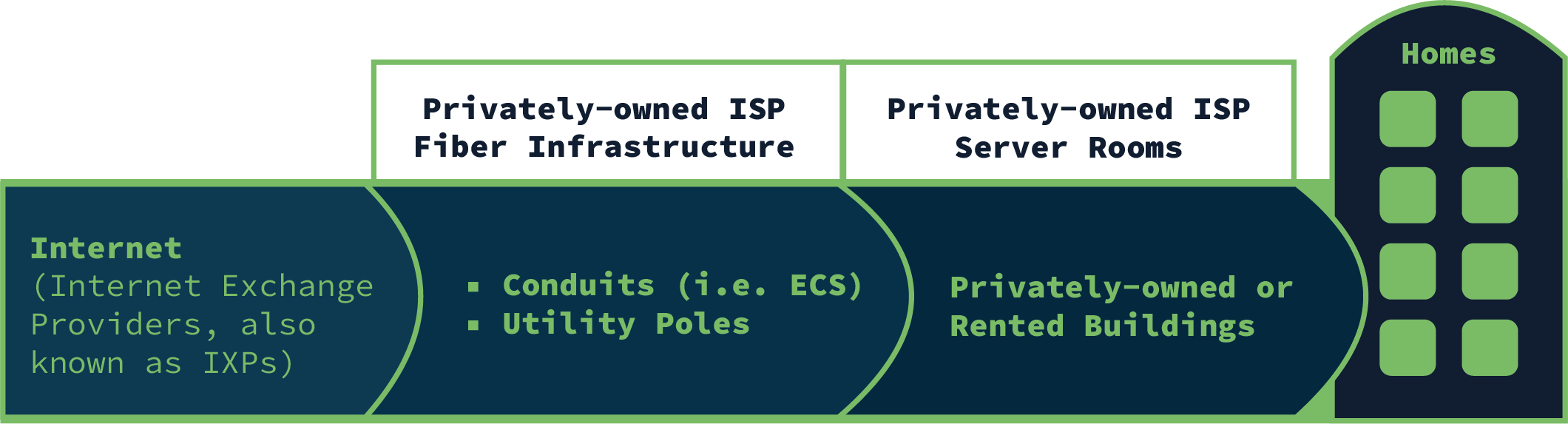
How the Internet Could Be Organized
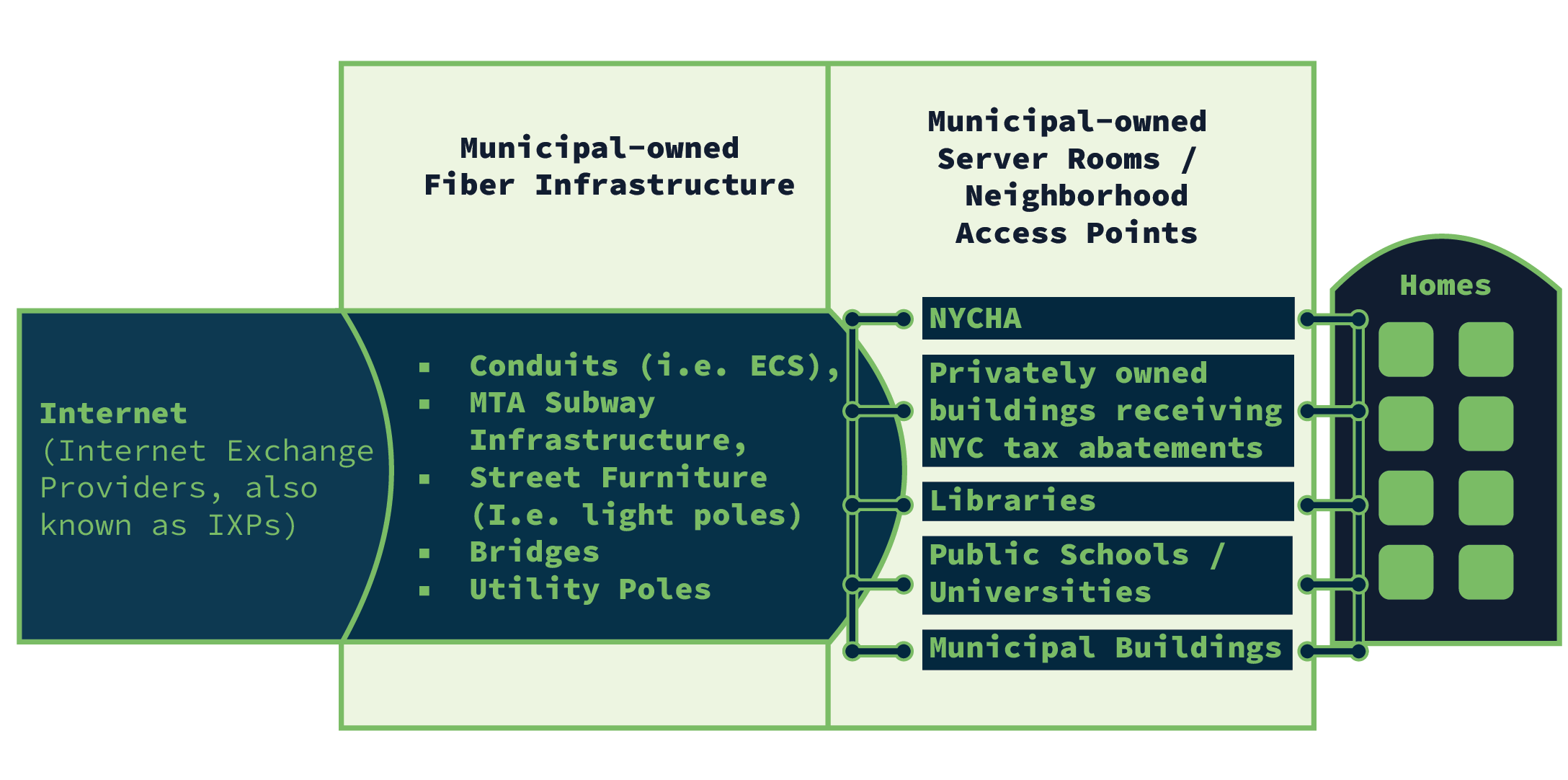
A note on laws by the State of New York regarding municipalities setting up a municipal internet: Under New York General Municipal Law Section 99-y, a municipality may purchase or construct its own internet services for New Yorkers. It may also receive a grant from the NYS Urban Development Corporation to fund this project [133]. To purchase a property, the municipality may contract with a non-profit or corporation to construct, maintain or repair the structure [134]. The City could also consider using power lines through a claim of eminent domain [135 - Eminent domain is a power of the government to take private property. The law has a very high standard to where it can be utilized. This power may only be utilized if there is a public interest that cannot be achieved without taking the property. The government must also provide just compensation to the property owners. This will have a fiscal impact for the government which includes the legal and compensation fees, as well as laying fiber-optic cables.] States and municipalities may set up their own broadband as Congress has not spoken to the federal government’s role in controlling state’s internet power. In 2021, New York State enacted the Comprehensive Broadband Connectivity Law to foster internet access to those with limited or no access [136 - NY CLS Pub Ser § 224-c]. The City can also use the NYC Small Business Services (SBS) to guide community-based ISPs and help reduce cost and ensure employment. Municipalities can create their own municipal broadband, but more importantly, it’s a moral imperative that will ensure sustainable affordable internet access for all New Yorkers.
Acknowledgements
Lead Authors:
- David Kahn, Community Organizer for Infrastructure and Environmental Justice
- Kashif Hussain, Deputy Public Advocate for Infrastructure and Environmental
- Justice
Additional support was provided by:
- Samuel Eluto, Legislative and Policy Associate
- Rosie Mendez, Director of Legislation and Policy
- Veronica Aveis, Chief Deputy Public Advocate for Policy
- Kevin Fagan, Director of Communications
- William Gerlich, Senior Advisor for Communications
- Matthew Carlin, Deputy General Counsel
Design and layout created by:
- Luiza Teixeira-Vesey, Digital Marketing Specialist
Photos by:
- Kashif Hussain, Deputy Public Advocate for Infrastructure & Environmental
- Justice
- David Kahn, Community Organizer for Infrastructure & Environmental Justice
Special thanks to:
- Abram Morris, Student Intern at Infrastructure & Environmental Justice Unit
- Neelan Martin, Student Intern at Infrastructure & Environmental Justice Unit
This report can be translated into over 100 languages at no cost. Please contact us at officeadmin@advocate.nyc.gov for more information.